
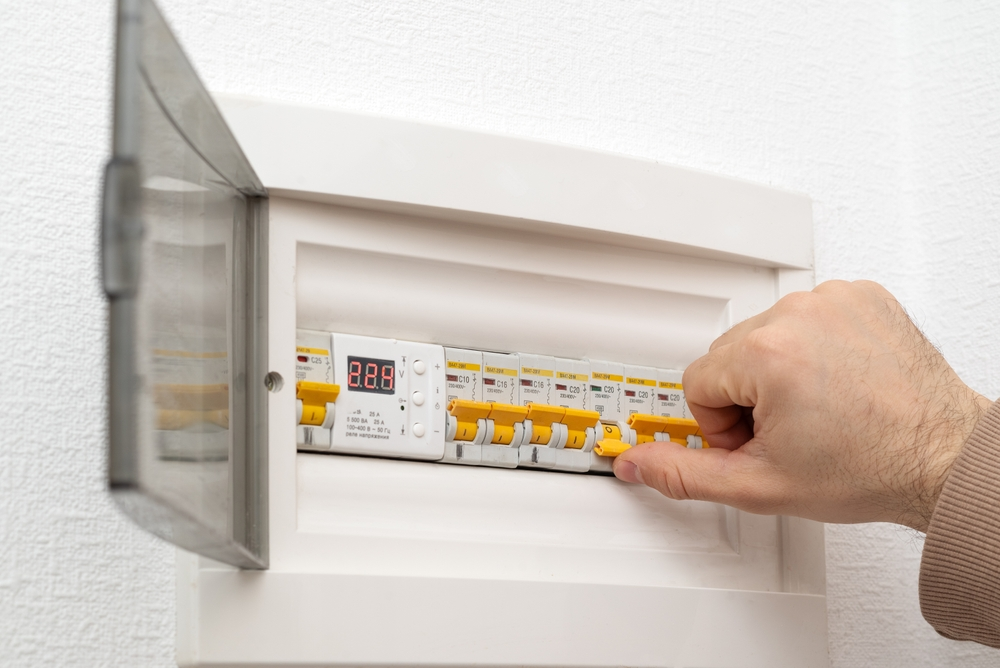
It is pouring outside, the lights flicker, and then the whole downstairs goes dark. You head to the consumer unit and, sure enough, the RCD has tripped again. You flick it back up, it holds for a while, and then the next downpour does exactly the same thing.
If that sounds familiar, your electrics are trying to tell you something. An RCD that trips every time it rains is almost always reacting to water getting into part of your electrical system. It is not being fussy. It is doing its job and protecting you from a potentially dangerous fault.
In this guide, we explain why rain sets off your RCD, the seven places water usually gets in, what you can safely check yourself and when it is time to call a qualified electrician.
Quick answer: An RCD trips in the rain because water has reached a cable, socket, fitting or junction box and is letting a small amount of electricity leak to earth. The most common culprits are outdoor sockets, garden lighting, external lights, cables to sheds and garden offices, and roof leaks reaching loft wiring or ceiling lights. Do not keep resetting it. Find the circuit, isolate it and get the fault tested by an electrician.
What does an RCD actually do?
An RCD (residual current device) is the switch in your consumer unit, usually marked with a small T or Test button. It constantly compares the electricity flowing out along the live wire with the electricity coming back along the neutral.
In a healthy circuit, those two figures match. If some of the current is escaping somewhere else, perhaps through water, damaged insulation or a person, the RCD notices the imbalance and cuts the power in a fraction of a second. Most household RCDs are designed to trip at around 30 milliamps, which is a tiny amount of current but enough to give someone a serious shock.
That is why the RCD matters so much. Electrical Safety First, the UK electrical safety charity, recommends RCD protection in every home and advises using plug-in RCDs if your consumer unit does not have one.
It is worth knowing the difference between an RCD and a circuit breaker (MCB):
| Device | What it protects against | What makes it trip |
|---|---|---|
| RCD | Electric shock and some fire risks | Current leaking to earth, often through water or damaged cables |
| MCB (circuit breaker) | Overheating cables | Too much current, such as an overloaded circuit or a short circuit |
| RCBO | Both of the above, on a single circuit | Either a leak to earth or an overload |
If it is the RCD that trips when it rains, rather than an individual breaker, you are almost certainly dealing with an earth leakage fault caused by moisture.
Why rain makes your RCD trip
Water conducts electricity, especially rainwater that has picked up dirt and salts on its way in. When rain seeps into a fitting or cable joint, it creates a path for current to leak from the live conductor to earth. The RCD detects that leak and switches off.
The tell-tale pattern is simple:
- It only happens in wet or stormy weather, or shortly after.
- It often stops once things dry out, which makes the problem easy to ignore.
- It gets worse over time, because water damage and corrosion build up with every downpour.
That last point is the important one. A fault that trips the RCD once a month this autumn can become one that will not reset at all by January.
7 common reasons your RCD trips when it rains
1. Outdoor sockets with worn or open covers
Outside sockets are the number one cause we see. Weatherproof covers crack, seals perish in the sun, and covers get left open after using the pressure washer or hedge trimmer. Rain gets behind the faceplate and straight onto the terminals.
Signs to look for: a cover that does not close properly, a cracked housing, rust or green corrosion on the terminals, or water inside the cover when you open it.
2. Garden lighting and water features
Garden lights, decking lights and pond pumps all sit right in the firing line. Cheap fittings, poorly sealed connections and cables buried without proper protection are common sources of leakage, particularly after heavy rain soaks the ground.
Signs to look for: lights that flicker or fail in wet weather, condensation inside lamp housings, or cable joints wrapped in insulating tape rather than proper waterproof connectors.
3. External lights, doorbells and security cameras
Porch lights, PIR floodlights, video doorbells and CCTV cameras are often fitted quickly and not always sealed properly where the cable enters the wall or the fitting. Water runs down the cable, into the back box and onto the connections.
Signs to look for: a fitting mounted where rainwater runs straight down the wall, missing rubber grommets, or a light that has filled with water.
4. Cables to sheds, garages and garden offices
Power run to an outbuilding needs to be the right type of cable, buried at the correct depth or properly supported, and connected using weatherproof glands. Extension leads running across the garden, or ordinary indoor cable clipped along a fence, are a recipe for wet-weather trips.
Signs to look for: the RCD trips when the shed or garage is in use, visible cable damage from strimmers or rodents, or a damp outbuilding with signs of a leaking roof.
5. Roof leaks reaching loft wiring and ceiling lights
Not every problem is outside. A slipped tile, failed flashing or blocked gutter can let water into the loft, where it lands on junction boxes, cables and the backs of ceiling light fittings below. If your RCD trips during heavy rain but nothing outdoors seems wrong, look up.
Signs to look for: damp patches or brown stains on ceilings, drips around light fittings, or wet insulation in the loft. Overflowing gutters and blocked downpipes make this much more likely, so a drainage check can be part of the fix.
6. Damp walls and cables passing through external walls
Where cables pass through an outside wall, for example to an outdoor socket, an air conditioning unit or a satellite dish, gaps around the entry point let water track inside. Penetrating damp in older properties can also affect sockets and switches fitted to external walls.
Signs to look for: sockets on outside walls that feel cold or look discoloured, black mould around switches, or crumbling plaster near cable entry points.
7. Too many circuits sharing one RCD
Many older consumer units use a single RCD to protect half the house. Every circuit has a small amount of natural leakage, and when you add those together with a little extra from damp weather, the total can tip over the RCD’s trip level. One minor wet-weather fault then takes out lights, sockets and the fridge all at once.
Signs to look for: a split-load consumer unit where one RCD covers several circuits, and trips that seem random rather than linked to one appliance. Upgrading to individual RCBOs means a fault on one circuit only switches off that circuit.
Safe checks you can do yourself
You can narrow the problem down without opening anything up. Only carry out these checks if you can reach the consumer unit safely and there is no water near it.
- Make sure your hands are dry and you are standing on a dry surface.
- Switch off and unplug outdoor equipment, garden lights and anything plugged into outside sockets.
- Switch off all the circuit breakers (MCBs) below the tripped RCD.
- Reset the RCD by pushing it fully down to off, then back up to on.
- Turn the breakers back on one at a time, waiting a few seconds between each.
- Note which breaker trips the RCD. That is the circuit with the fault. Leave it switched off and label it.
If the RCD will not reset even with every breaker switched off, the fault may be in the consumer unit itself or the RCD may have failed. That needs an electrician straight away.
While you are at the consumer unit, it is good practice to press the Test button every three months or so, as most manufacturers recommend. If the RCD does not trip when tested, it is not protecting you and should be replaced.
What you should never do
- Never tape, wedge or bypass an RCD to stop it tripping. It removes your protection against electric shock.
- Do not keep resetting it over and over. Each trip is a warning of a real fault.
- Do not open up outdoor sockets, lights or junction boxes while they are wet or live.
- Do not use outdoor electrical equipment in the rain until the fault is found and fixed.
- Do not ignore it because it stops when the weather dries out. The damage is still there.
When it is an emergency
Some signs mean you should switch off at the main switch and call an emergency electrician immediately:
- Water dripping from a ceiling light or through a light fitting
- A burning smell, smoke or scorch marks on sockets, switches or the consumer unit
- Crackling or buzzing from a fitting or the consumer unit
- Anyone getting a tingle or shock from a tap, appliance or metal surface
- The RCD will not reset at all and you have no power to essential circuits
Our 24/7 emergency electricians can attend day or night, including weekends and bank holidays. Call 020 3318 8667.
If the power cut affects your whole street rather than just your home, the problem is likely with the network. Call 105, the free national power cut number, to report it to your local network operator.
How an electrician finds and fixes the fault
A wet-weather RCD fault can be tricky to trace, especially if it only shows up during heavy rain. A qualified electrician will usually:
- Carry out insulation resistance testing on each circuit to measure exactly where current is leaking to earth.
- Inspect outdoor sockets, lights and cable entries for water ingress and corrosion.
- Replace damaged fittings with properly rated weatherproof products. For outdoor use, look for an IP rating of at least IP65 or IP66.
- Reseal or reroute cables where they pass through walls or run to outbuildings.
- Recommend a consumer unit upgrade to RCBOs if one RCD is covering too many circuits.
- Issue an Electrical Installation Condition Report (EICR) if your wiring has not been inspected recently.
Always use a registered electrician. You can check credentials on the Electrical Competent Person Register or through the Electrical Safety First find an electrician tool. For a guide to typical call-out charges, see our rate guide.
How to stop it happening again
A little preparation before the wet season makes a big difference:
- Check outdoor socket covers close fully and the seals are intact.
- Unplug outdoor equipment and garden lights you are not using over winter.
- Clear gutters and downpipes so rainwater cannot back up into the roof space.
- Look in the loft after heavy rain for drips, damp insulation or water near cables.
- Replace cheap indoor-rated fittings used outside with proper outdoor-rated versions.
- Test your RCD every three months using the Test button.
- Book an EICR if your electrics have not been inspected in the last ten years, or five years if you are a landlord.
Keep an eye on Met Office weather warnings too. When heavy rain or a storm is forecast, our 30-minute storm prep checklist covers the quick jobs that protect your home. And if your heating is playing up at the same time, see our guide to common problems when the heating goes on for the first time.
Frequently asked questions
Is it dangerous if my RCD keeps tripping in the rain?
The RCD itself is keeping you safe, but the fault behind it can be dangerous. Water in electrical fittings creates a risk of electric shock and, in some cases, fire. Repeated trips should always be investigated by a qualified electrician.
Why does my RCD trip at night when it rains?
Outdoor lights and security lights often switch on automatically at dusk. If one of them has water inside, the fault only appears once the light turns on, so the RCD trips in the evening or overnight during wet weather.
Can a faulty appliance cause the RCD to trip only when it rains?
It is possible if the appliance is outside or in a damp outbuilding, such as a freezer in the garage or a pond pump. Unplugging outdoor appliances one at a time can help you identify the culprit.
Can I replace an outdoor socket myself?
Work on outdoor circuits and new outdoor sockets is notifiable under Part P of the Building Regulations in England and Wales. It should be carried out by a registered electrician, who will certify the work.
Will a new consumer unit stop my RCD tripping?
Not on its own. A new consumer unit with RCBOs will stop one fault from switching off half your home, but the water leak causing the fault still needs to be found and repaired.
Need help with a tripping RCD?
If your RCD keeps tripping every time it rains, do not wait for the fault to get worse. Our local, qualified electricians can trace the leak, make your outdoor electrics safe and get your power back on.
We cover the whole of England and Scotland, including London, Leeds, Bristol, Nottingham and Sheffield.
Call 24/7 on 020 3318 8667 or request a callback and a local electrician will be in touch.